Strategic-Based Audit Model: A Vessel in Navigating Dynamic Governmental Landscape

Authors: Akhsanul Khaq and Candra Hapsari Susilo, The Audit Board the Republic of Indonesia (SAI Indonesia)
Introduction
The Audit Board of the Republic of Indonesia (BPK) is constitutionally mandated as an independent body, reflecting the INTOSAI Lima Declaration (1977), which underscores the importance of legal, organizational, and operational independence in ensuring accountability. However, Indonesia’s evolving political and institutional landscape introduces challenges to this mandate. The 2024 presidential transition initiated a new development cycle under Law No. 25/2004, requiring each administration to prepare a National Medium-Term Development Plan (RPJMN) aligned with the Long-Term Development Plan (RPJPN). This process has involved ministerial restructuring, the establishment of new agencies, and the launch of flagship initiatives, such as the free nutritious meal program, all of which reshape governance arrangements and audit priorities.
The RPJPN 2025–2045 articulates four strategic goals: achieving developed-country income levels, reducing poverty and inequality, enhancing global leadership, and strengthening human capital. Attaining these objectives demands robust governance, efficient resource use, and effective oversight. Yet political transitions, shifting ideologies, and administrative restructuring often disrupt policy continuity, complicating long-term planning. Within this dynamic context, critical questions emerge: how can BPK safeguard its functional independence, and how can its audit approach remain responsive and relevant to shifting development agendas?
National Priorities and Our Part
For BPK, this implies that audit strategies must remain adaptive and responsive to ongoing changes. In light of today’s evolving development context, several implications emerge for its role and approach, which can be framed through four key national priorities as outlined below:
1. Economic Transformation and High-Value Investments
Raising income to developed-nation levels involves large-scale investments in infrastructure, industrial policy, and innovation. BPK must ensure that these investments are efficient, transparent, and impactful, requiring audits that go beyond compliance and into value-for-money and outcome-based assessments.
2. Social Inclusion and Poverty Reduction
Efforts to reduce poverty and inequality will be implemented through expansive social programs, subsidies, and targeted development funds. BPK must assess program design, implementation integrity, and benefit distribution, with greater focus on effectiveness and equity, not just financial regularity.
3. Global Engagement and International Influence
Indonesia’s increased participation in international forums and initiatives implies more cross-border spending, diplomacy-related funding, and global partnerships. BPK will need to ensure accountability in international cooperation, aligned with international auditing standards and transparency expectations.
4. Human Capital and Competitiveness
Massive public investment in education, health, and workforce development calls for audit approaches that can assess long-term strategic outcomes and institutional readiness. Ensuring the quality and impact of these programs is key to achieving RPJPN’s long-term vision.
Addressing these implications requires not only adaptive audit approaches but also institutional alignment. Thus, ensuring coherence between BPK’s Strategic Plan and the broader National Strategic Plan is critical for embedding audit functions within Indonesia’s long-term development trajectory.
Alignment of the Institutional Strategic Plan to the National Strategic Plan
Based on Presidential Decree No. 80 of 2025, Indonesian government institutions must prepare five-year strategic plans aligned with the RPJMN, itself derived from the RPJPN toward Indonesia 2045. The 2025–2029 RPJMN marks the first stage of this agenda, emphasizing poverty reduction, human capital development, and sustainable economic growth (Bappenas, 2024).
In line with these priorities, BPK’s Strategic Plan aims to enhance audit value and impact by strengthening institutional capacity, deepening audit quality, and integrating digital innovation. BPK stands as both an unwavering guardian of accountability and a forward-looking partner in driving the nation’s development agenda. Guided by this dual mandate, our institution is determined to solidify its reputation as a credible, trustworthy, and influential institution whose work directly shapes the success of national objectives. This ambition comes to life through three defining missions:
- Ensuring the integrity and impact of state financial management and reporting;
- Driving the fight against corruption while enabling the recovery of state losses from financial mismanagement;
- Upholding governance that is truly independent, transparent, and accountable
These missions form the foundation for the development of BPK’s Strategic-Based Audit Model, a framework aimed at broadening the role of auditing from mere compliance and assurance, toward becoming a strategic instrument that supports governance reform, drives accountability, and contributes directly to national development priorities.
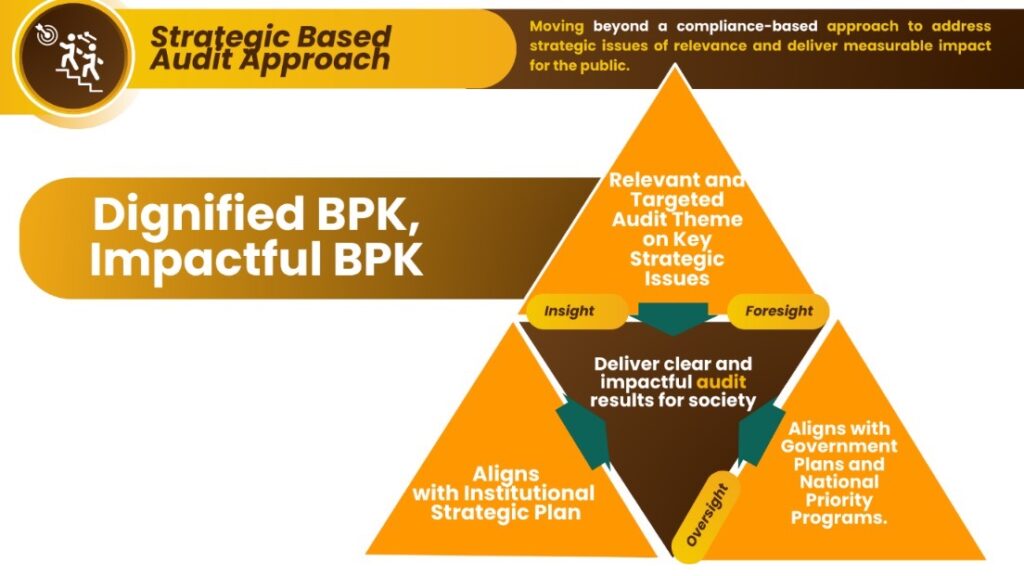
Dignity and Impact: Strategic-Based Audit Model
Elem (2016) argues that policy’s true value lies not in its written vision but in the resolve of those who implement it. Echoing this, INTOSAI P-12 highlights that SAIs add value by impacting citizens’ lives.
Grounded in these principles, the Strategic-Based Audit Model aims to elevate auditing from routine compliance into a tool that actively supports national development.
The institutional ethos in the previous section is encapsulated in the tagline, BPK Bermartabat dan Bermanfaat, directly translated as Dignified Audit Board of Indonesia, Impactful Audit Board of Indonesia. A short and simple phrase on our commitment as a dignified institution and a force for meaningful change in public financial governance. Bermartabat reflects our unwavering dedication to independence, integrity, and professionalism, values that anchor our credibility and public trust. Bermanfaat speaks to our purpose: that our work must go past formality, producing insights and recommendations that improve governance, enhance public services, and ultimately serve the people.
Strategic-Based Audit in Public Sector Settings
In detail, we believe that an impactful audit can be achieved by focusing on three key points:
1. The Government National Plan and Priority Programs
The foundation of a strategic-based audit begins with a clear understanding of the government’s National Development Plan (e.g., RPJMN/RPJPN) and its priority programs. These documents define the government’s vision, mission, and measurable targets over the medium and long term. They outline areas of focus such as poverty reduction, infrastructure development, digital transformation, education, health, and sustainability. By aligning audits with these priorities, the SAI ensures that its work supports national goals and provides accountability for the use of public funds in strategic areas.
2. Institutional Strategic Plan
To remain effective and relevant, the audit institution itself must operate under a well-defined Strategic Plan that translates its constitutional mandate into actionable priorities. This includes setting objectives for improving audit quality, adopting new methodologies, strengthening institutional capacity, enhancing stakeholder engagement, and promoting innovation. The strategic plan acts as a compass to guide the organization in identifying which areas to audit, what capacities to build, and how to respond to emerging risks and governance challenges. When the institutional strategic plan is aligned with the national development agenda, it strengthens the coherence and impact of audit interventions.
3. Relevant and Targeted Audit Theme on Key Strategic Issues
A strategy-based audit approach emphasizes selecting themes aligned with key strategic issues—such as climate change, digital transformation, inequality, debt, and governance—through risk-based planning, consultation, and trend analysis. This ensures BPK is able to provide oversight, insights, and foresight, enhancing credibility, relevance, and significance on public outcomes.
Implementation: Thematic Audit 2025 on Human Development and Food Stability
As part of its Strategic-Based Audit approach, the Audit Board of Indonesia is currently conducting thematic audits aligned with the government’s national priorities, specifically targeting the areas of human development and food security. These themes were selected due to their strategic significance in achieving the goals outlined in the RPJMN and RPJPN. Rather than focusing solely on individual entities, the audits are designed to assess policy coherence, implementation effectiveness, and inter-agency coordination across several ministries and government units.
Each theme is further broken down into a set of “quick-wins”, representing high-impact initiatives that are expected to deliver measurable outcomes within a shorter time frame. To capture the full implementation landscape, these audits are carried out not only at the central government level but also involve SAI’s regional offices, which assess execution at the local level, including municipalities, districts, and even villages.
This integrated audit model supports the pillars of oversight, insight, and foresight: providing assurance on legality and performance, generating evidence-based evaluations of program delivery, and identifying risks or systemic issues that may affect long-term outcomes. Ultimately, this reflects BPK’s commitment to delivering meaningful, relevant, and forward-looking audit results that support improved governance and better public services across all levels of government.
Conclusion
In an era of evolving national priorities and shifting institutional landscapes, the adoption of the Strategic-Based Audit Model represents a forward-thinking commitment to both institutional dignity and public impact, grounding its work in the pillars of oversight, insight, and foresight, and aligning with key government priorities and strategic themes, BPK ensures its audits remain relevant, responsive, and results-oriented. Through initiatives such as the thematic audits on human development and food stability, BPK demonstrates how independent audit institutions can serve not only as guardians of public accountability but also as strategic partners in national development. As BPK continues to carry out its mandate with independence, integrity, and professionalism, it upholds its dual promise to be dignified in stature and impactful in service.
Bibliography
- BAPPENAS. (2024). Rencana Pembangunan Jangka Panjang Nasional (RPJPN) 2025–2045. Ministry of National Development Planning/National Development Planning Agency. https://indonesia2045.go.id
- Elem, J. (2016). Public policy and governance: From vision to implementation. Routledge.
- International Organization of Supreme Audit Institutions (INTOSAI). (1977). Lima Declaration of Guidelines on Auditing Precepts. International Organization of Supreme Audit Institutions.
- International Organization of Supreme Audit Institutions (INTOSAI). (2019). INTOSAI-P 12: The value and benefits of Supreme Audit Institutions – Making a difference to the lives of citizens. International Organization of Supreme Audit Institutions.
- Peters, B. G., & Pierre, J. (2006). Handbook of public policy. SAGE Publications. https://doi.org/10.4135/9781848608054
- Republic of Indonesia. (2004). Law No. 25 of 2004 on National Development Planning System. Government of the Republic of Indonesia. Retrieved August 19, 2025, from https://peraturan.bpk.go.id
- Republic of Indonesia. (2025). Presidential Decree No. 80 of 2025 on The Formulation Of Institutional Strategic Plan and Work Plan. State Secretariat of the Republic of Indonesia. https://peraturan.bpk.go.id
- State Secretariat of The Republic of Indonesia. (2025). Presidential speech on the launch of the national free nutritious meal program. State Secretariat of the Republic of Indonesia.