Tag: ASOSAI

Filter By:
Sort By:
The Cooperative Audit on Climate Change Adaptation Actions launched at the INCOSAI XXV

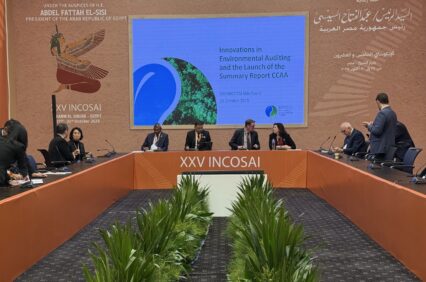
The INTOSAI Working Group on Environmental Auditing (WGEA) side event, “Innovations in Environmental Auditing”, at the INCOSAI spotlighted the latest innovations within the INTOSAI WGEA community. First, highlighting some of the recent innovations, Vivi Niemenmaa from the WGEA Secretariat introduced the new agile support system, Audit Clinic, that has been piloted in 2025 with outstanding feedback. This is a mechanism where SAIs can book a one-hour consultation slot with a more experienced SAI to discuss any environmental audit related issue. As another innovation, Dashiell Da Costa from SAI Brazil, revealed the first results of the second assessment round of the ClimateScanner, covering assessments from 100 SAIs. The official launch was foreseen in the COP30 Climate Conference.  

saudi fisp panel
Saudi Fund for Improved SAI’s Performance (Saudi FISP) Meet & Greet – Highlights from the Side Event at INCOSAI XXV in Sharm El Sheikh

During Sharm El-Sheikh INCOSAI XXV, the General Court of Audit (GCA) of the Kingdom of Saudi Arabia organized a side event titled “FISP Meet & Greet”, bringing together beneficiaries of the Saudi Fund for Improved SAI Performance (FISP). The Saudi FISP is a funding initiative established by the GCA under the leadership of its President, H.E. Dr. Hussam Alangari. Since 2020, the GCA has allocated 1 million U.S. dollars annually to support the needs of Supreme Audit Institutions (SAIs) in developing countries, helping INTOSAI respond to the increasing demand for direct capacity-building assistance. By 2026, the fund had reached a total value of 7 million U.S. dollars, with continued growth anticipated.

Collage PESA INCOSAI
PESA Leads the Way as Professional Qualification for SAI Auditors in Public Sector Auditing at INCOSAI XXV

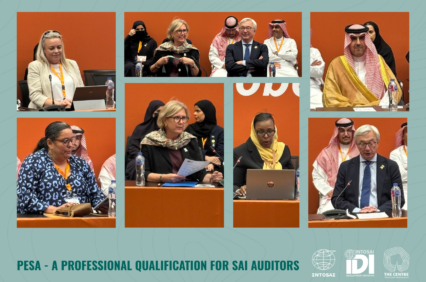
At the XXV INCOSAI, a dedicated side event celebrated INTOSAI’s formal recognition of the Professional Education for Supreme Audit Institution (SAI) Auditors (PESA) qualification, highlighted the launch of INTOSAI co-branding and the Arabic version of the qualification, and supported a key motion at INCOSAI. The INTOSAI community came together to support PESA in its journey, including Supreme Audit Institutions, (SAIs), experts, and partners who had contributed to professionalising public sector auditing.

Jurisai meeting at INCOSAI
JURISAI is Now an Associated Entity of INTOSAI! 

INCOSAI 2025, the INTOSAI Congress, represented a decisive step for JURISAI members since the inaugural General Assembly held in Paris in October 2024.

The Audit Board of the Republic of Indonesia to Host Next INCOSAI in 2028

The Audit Board of the Republic of Indonesia (Badan Pemeriksa Keuangan RI, or BPK), Indonesia’s Supreme Audit Institution (SAI), will host the XXVI International Organization of Supreme Audit Institutions (INTOSAI) Congress (INCOSAI) in 2028 in Bali, Indonesia.

Key Adoptions, Endorsements, and Appointments Made at INCOSAI XXV

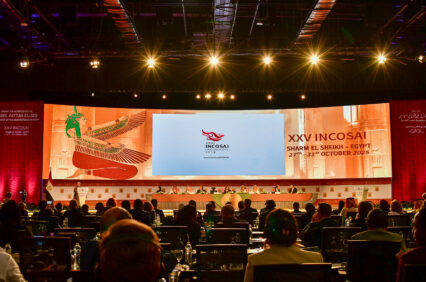
A successful INCOSAI is reflected in broad knowledge exchange, meaningful dialogue, strengthened international cooperation, and collective decision-making on priority matters. During the Congress, and at the preceding 79th INTOSAI Governing Board meeting, the INTOSAI community convened to present, deliberate, and reach consensus on several significant issues, including the adoption of the triennial budget, the endorsement of new professional pronouncements, the approval of the Sharm El-Sheikh Declaration, and the appointment of new INTOSAI Governing Board members, among other important outcomes.

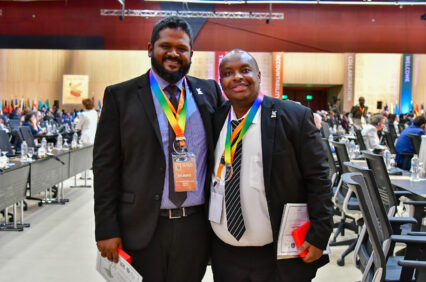
SAI Young Leaders from Kenya and the Maldives Recognized for Excellence in Transformation and Innovation

The INTOSAI Development Initiative (IDI)’s SAI Young Leaders Awards celebrate and recognize innovation, collaboration and transformation brought by young leaders through their change strategy projects from the SAI Young Leaders Initiative. The SAI Young Leaders Initiative aims to support young leaders from SAIs to implement a change strategy to bring real and positive shifts in the SAI. 

INCOSAI 25 Kimi Makwetu Award Ceremony
AFROSAI-E Wins the Kimi Makwetu Award for Excellence in Capacity Building

The Kimi Makwetu Award was presented to AFROSAI-E by the International Organization of Supreme Audit Institutions (INTOSAI) at the XXV INCOSAI in Sharm El-Sheikh, Egypt. The INTOSAI Kimi Makuetu Award spotlights the best of capacity building in the INTOSAI community, and honors institutions that demonstrate outstanding commitment to strengthening the skills, systems, and sustainability of Supreme Audit Institutions (SAIs) worldwide.

Dr. Hussam Alangari, President of the General Court of Audit of the Kingdom of Saudi Arabia, recipient of the INTOSAI Future Award.
President Dr. Hussam Alangari Accepts the INTOSAI Future Award on behalf of the General Court of Audit of Saudi Arabia

The International Organization of Supreme Audit Institutions (INTOSAI) presented the INTOSAI Future Award at the XXV INCOSAI in Sharm El-Sheikh, Egypt on October 31, 2025. The INTOSAI Future Award, recognizes meritorious services in government auditing and is granted to a SAI for future-oriented achievements and outstanding contributions to INTOSAI community, organization stewardship, and leadership priorities. The INTOSAI Future Award represents a new iteration of the former Jörg Kandutsch Award.  

News in Brief
News in Brief
Mongolian National Audit Office and SAI Independence
March 19, 2026
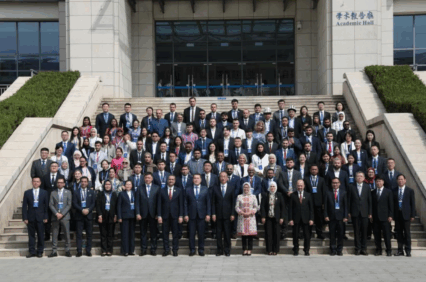
ASOSAI Young Auditors Meet in China

The first Young ASOSAI Excellence Program was held in Nanjing and Shanghai, China from September 22nd to 26th, 2025. More than 90 young auditors from 42 SAIs attended the program. 

SAI Independence of Nepal: Triumphs and Challenges

The term “Supreme Audit Institution (SAI) independence” is defined as the ability to accomplish tasks objectively and effectively and to be protected against outside influence. Such independence, or a necessary degree of independence, shall be laid down in the Constitution, details may be set out in legislation, and an independence audit mandate shall be guaranteed (Lima Declaration 1977). Organizational independence refers to financial, managerial, and administrative autonomy (The Mexico Declaration, 2007). It is achieved through the application of key principles, various means, and safeguards that promote accountability and ensure transparency.

Auditing Sensitive Government Bodies: Finding the Right Balance Between Transparency and Security

The independence of Supreme Audit Institutions (SAIs) is an essential element to ensure the effectiveness of auditing. It ensures that audit results are objective, credible, and free from external influence. Independence reinforces public confidence in the audit process and strengthens accountability mechanisms in government. Although, when auditing sensitive government entities, such as national security agencies, SAI independence can encounter significant challenges.

Strengthening BPK’s Independence: Leveraging Strategic Planning, Digital Innovation, and Institutional Integrity

Independence is not merely a theoretical principle in the governance of state financial audit institutions, but rather an absolute requirement for the realization of credible public accountability. Independence is the primary foundation of INTOSAI-P10. INTOSAI-P10 emphasizes that the Indonesian Audit Board can only be objective and effective if it is independent from the audited entity and protected from external influences. Public trust is the greatest asset for any state institution. This trust is born from one fundamental key: independence, namely the freedom to work objectively, honestly, and free from pressure from any party. The independence of the BPK is the primary foundation for audit results to be recognized, trusted, and have a real impact on improving state financial governance. 

Strengthening SAI Independence: Global Progress and the Saudi Experience

Supreme Audit Institutions (SAIs) are pivotal in safeguarding public resources, ensuring that governments are held accountable and fostering transparency in the management of public funds. A key to fulfilling this role is their independence from undue external influence, which allows them to perform audits with objectivity and credibility. As emphasized by INTOSAI’s guidance, SAIs operate most effectively when shielded from interference, allowing them to properly strategize, acquire necessary information, and report findings without restrictions (INTOSAI, 2019). Political influence, budgetary constraints, and limited access to records can undermine audit quality and public trust. This article examines how the General Court of Audit (GCA) of Saudi Arabia has successfully navigated challenges to its independence through robust legal frameworks and disciplined execution, offering practical insights that other SAIs can adopt to reinforce independence and thereby enhance governance and public confidence.

Upholding Independence: Triumphs and Challenges of the Royal Audit Authority of Bhutan

Supreme Audit Institutions (SAIs) are crucial for good governance, accountability, and transparency. In Bhutan, the Royal Audit Authority (RAA) audits public resources, with its effectiveness critically dependent on independence amidst political, economic, or institutional pressures. This article examines SAI Bhutan’s real-world experiences, highlighting its successes in safeguarding independence and the persistent challenges it faces, drawing insights from official publications, peer reviews, and specific audit cases.

Integrated Approach for Impactful Financial Audit: Insights from SAI Indonesia

This paper examines the integration of performance audit perspectives into financial audits on the Audit Board of the Republic of Indonesia’s (BPK) by using the Financial Audit with Performance Audit Perspective (FAPA) framework. This paper demonstrates how FAPA approach, documented through Long-Form Audit Reports, enhances audit impact by evaluating both financial accuracy and operational effectiveness. Despite challenges in methodological alignment, stakeholder management, timing, and coordination, we present a structured workflow model for effective implementation of the FAPA framework. The paper advocates for further integration of sustainability and foresight elements to promote long-term value creation in public financial management, better meeting evolving stakeholder expectations and supporting Sustainable Development Goals.

News in Brief
News in Brief
President of GCA Presents Peer Review Report to His Azerbaijani Counterpart
December 5, 2025
Inside INTOSAI
Inside INTOSAI
The First ASOSAI-ARABOSAI Joint Meeting Convenes
July 28, 2025
Inside INTOSAI
Inside INTOSAI
62nd Meeting of ASOSAI Governing Board Held in Azerbaijan
July 28, 2025
Auditing Infrastructure in Indonesia: Addressing Challenges in Closing the Infrastructure Investment Gap

Infrastructure is a fundamental part of economic growth, contributing to approximately 14% of the global gross domestic product (GDP). The lack of robust infrastructure can have wide-ranging consequences, affecting societal risks such as societal polarization, health and well-being, inequality and lack of economic opportunity or unemployment. The Word Economic Forum (WEF) stated that insufficient public infrastructure ranks among the top 20 global risks. Given its significance, leveraging infrastructure is essential for fostering economic development. 

Enhancing the Role of Auditing in Building a Safe and Resilient Water Network

In China, water security is considered a critical aspect of infrastructure, focusing on optimizing the water resource distribution system and improving the flood control and disaster mitigation system. In 2022, to accelerate the construction of a national water network and build a modern, high-quality water infrastructure network, and to comprehensively address issues of water resources, water ecology, water environment, and water disasters, the Chinese government issued the “National Water Network Construction Planning Outline” (hereinafter referred to as the “Water Network Plan”). In 2023, the National Audit Office of China carried out a special audit on construction and operation of major water diversion projects, aiming to assist in building a safe and resilient modern water network. The audit focused on revealing prominent problems in the construction and operation of major water diversion projects and finding out the systemic barriers, mechanistic defects, and institutional loopholes behind these issues. This article, based on relevant planning and constructions of the national water network, studies key areas that audits should focus on, and discusses experiences, practices of audit, and shares typical cases for reference.