From Compliance to Performance Evaluation—the State Audit and Administrative Control Bureau of Palestine’s Performance Audit Transition

Author: Mrs. Amal Faraj, President of the State Audit and Administrative Control Bureau (SAACB) of the State of Palestine
In a world of rapid changes and increasing challenges, governments are asked more than ever to have concrete findings, provide high quality public service and manage the available resources efficiently, effectively and responsibly. With these changes, the public audit is not only viewed as just ensuring compliance with laws and protocols but also evaluating the performance and measuring the actual influence of government policies and programs on lives of citizens.
Performance audit is a qualitative leap in the modern audit thinking, as a strategic tool that helps answer the significant questions on whether the goals are achieved, efficient use of resources, effective government interventions to address the development, economic and social challenges.
The State Audit & Administrative Control Bureau is the supreme audit institution of Palestine, responsible for public sector audit by producing audit reports that intend to increase good governance, improve institutional performance, ensure the best use of public funds and increase transparency, accountability and integrity.
The Bureau realized early on the importance of this global shift in audit practices, so it embraced an ambitious vision to develop its role from an institution that audits compliance to one that helps improve performance, bring an impact and cementing the public value. This shift was not just developing action tools or an expansion of mandate, but an integrated institutional project based on building capacity, developing methodology, supporting professional partnerships and establishing a culture based on continuous learning and innovation.
Over the past years, the Bureau has taken advanced steps to institutionalize and develop performance audit according to international audit standards, making use of pioneering international experience, and following the best professional practices that focus on findings, impact and value added.
Challenges to Performance Audits
The Bureau encountered two major challenges against implementing effective performance audit. First, the Bureau had limited resources and staff had limited competencies in performance audit. Second, there was no clear legal mandate that authorizes the Bureau to practice this form of audit.
Although performance audits are important to improve public service and increase the government spending efficiency, the absence of necessary institutional and legislative components was an obstacle to developing a performance audit function.
Looking For a Solution through Strategic Peer to Peer Partnership
The Bureau has been keen to develop audit tools, so a strategic method based on having a partnership with a peer SAI with established experience in performance audit was adopted. This led to the partnership with the Swedish National Audit Office, which helped convey the knowledge and experience and build the institutional professional capacity of the Bureau.
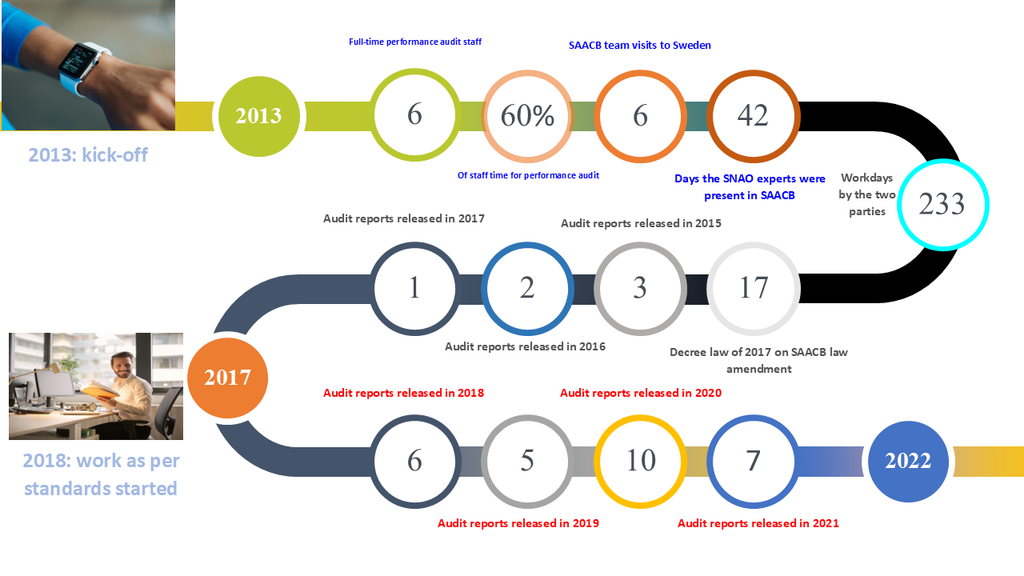
The peer SAI cooperation focused on developing and practicing performance audit methods and aligning the actions of the Bureau per international standards, and training and providing the auditors with necessary technical experience for performance audit reporting. Additionally, the Bureau established a specialized institutional core to develop the performance audit function.
The cooperation’s first phase paid attention to building the professional basis of performance audit by developing and producing actual performance audits, publishing high quality reports with concrete influence and evidence, and; enhancing communication with stakeholders to ensure useful report findings.
As a result of the capacity building efforts and alignment to INTOSAI standards, this phase produced six performance audit reports, which served as the actual launching pad for this trajectory. In regards to the legal basis challenge, SAACB law of 2017 has also been amended so performance audit is one of the audit forms the Bureau undertakes, alongside financial and compliance audits.
Performance Audit Institutionalized and Developed
After setting the legal and professional basis, the Bureau moved towards a more advanced phase that focused on performance audit institutionalizing and sustainability, by:
- Establishing a special performance audit department as part of the Bureau’s organizational structure.
- Including performance audit as part of the strategic plan (2017-2021).
- Preparing a professional performance audit guide and reference worksheets.
- Providing training programs for both auditors and managers to raise awareness and expand their professional methodology.
- Developing protocols for quality assurance, report reviewing and audit plans.
- Enhancing communication with audited entities and stakeholders to explain and make use of report findings.
- Exchanging the experience with peer SAIs in sustainable development goals (SDGs) performance audit as part of the ‘Sharaka’ program with the Dutch SAI.
Findings and Achievements
By the end of 2025, the Bureau released more than 70 performance audit reports that included different vital sectors in Palestine. These reports are now an important reference for the government, decision makers, audited entities and the public.
These performance audit reports also helped the Bureau develop measurement protocols for findings and influence in the public sector and support decision-making by providing practical and enforceable recommendations. By publishing performance audit reports publicly and on social media platforms, the Bureau enhances the transparency of public policies implemented. The Bureau has established itself as an audit institution that pays attention to findings and value added,
Findings of the experience for the Bureau were not just about developing the audits, but also directly helping improve the public service. The recommendations that stemmed from the performance audits contributed to real positive impact to public programs, including but not limited to:
- Reduced waiting time at emergency rooms in hospitals.
- The development of a unified system to monitor and manage medical equipment.
- Regulation of x-ray imaging wards in government hospitals.
- Application of preventive maintenance for water networks to reduce losses.
- Increases of inspection rounds of goods in markets.
- Appointment and empowerment of the disabled in public service.
The cabinet is using a number of performance audit recommendations upon releasing government decisions and policies.
The experience of the Bureau shows that the shift towards performance audit is not just a development of audit tools, but a strategic transition in the audit thinking that intends to move from focus on compliance to measurement of findings and actual impact of government policies and programs.
Thanks to this shift, the Bureau is now more able to contribute into improving the government performance and governance system, and enhancing the public service quality, in order to have its vision to make a concrete difference in lives of Palestinian citizens.
Looking Forward
We are today on the verge of a new phase of institutional development. The rapid digital changes and the increasingly complex environments of government work mean that innovation is the main foundation for the performance audit future. Supreme audit institutions do not only evaluate the past events, but are also required to disclose and evaluate risks, make use of future opportunities and employ modern technology for data analysis and directions that support decision makers. The Bureau, driven by this view, is enhancing the use advanced digital tools, benefiting from data analytics and artificial intelligence, developing more resilient and proactive audit means and having more effective communication channels with audited entities by setting internal control units therein in force, which helps raise the audits efficiency, improve output quality and strengthen the audit recommendations impact.
Our vision for the future is having more intelligent, proactive and influential audits, which can explore risks, analyze directions, evaluate findings comprehensively, and provide visions and recommendations that support decision making, enhance the public administration efficiency and bring sustainable development.
The citizen will be the pivot of our attention and effort. The real value is not measured by the number of reports or observations, but with the positive influence brought into the public service quality, institutional efficiency and level of trust between citizens and state foundations.
The performance audit journey of the Bureau represents an institutional transition story and professional willingness, which believe that the modern audit is a development and reform partner, and that innovation is not an interim choice but a long-lasting method to keep pace with the future and make positive change.
As the Bureau is keeping the innovation and development quest, it renews the compliance with adopting the best international practices and standards, enhancing its part as national audit institution that protects the public funds, establishing the sustainable development and bringing the best possible value for the Palestinian citizens.