Data Science to Measure Out-of-Pocket Costs for Women with Breast Cancer

By Appoline Chariot, data scientist at the French Cour des comptes
What do women with breast cancer actually pay for their treatment? Providing a rigorous answer based on available data poses a significant methodological challenge.
An investigation by the Cour des comptes, the French SAI, focused on breast cancer prevention and treatment, with the goal of better understanding the financial impact of the disease on patients.
To answer this question, the audit team consulted the SAI’s “Data Analysis and Science” department (DASD), which drew on data from the National Health Data System (SNDS). This data enabled the development of a measure of out-of-pocket costs after reimbursements from mandatory health insurance coverage for women with breast cancer.
Developing a Measurable Indicator Based on Medical-Administrative Data
To measure out-of-pocket costs, we must first clarify this concept, which has no single definition and does not exist directly in medical-administrative databases.
SNDS data allowed the Cour des comptes to observe the care received and the reimbursements made by mandatory health insurance for each patient. However, they do not allow to reconstruct the actual final cost borne by the patient, as reimbursements from supplemental health insurance and expenses related to non-reimbursed care are not included.
The analysis therefore focused on out-of-pocket costs after reimbursement by mandatory health insurance and before any potential reimbursement by supplemental health insurance, with the actual out-of-pocket costs depending on the level of supplemental coverage.
The role of the data scientist is not limited to the implementation of quantitative methods: it requires a detailed understanding of the healthcare system, in this case, and of public policy issues – an essential prerequisite for identifying relevant data, interpreting its limitations, and constructing robust indicators. This expertise enables the data scientist to bridge the gap between public policy evaluation questions and their analytical formalization.
Reconstructing Out-of-Pocket Costs from Billions of Data Points
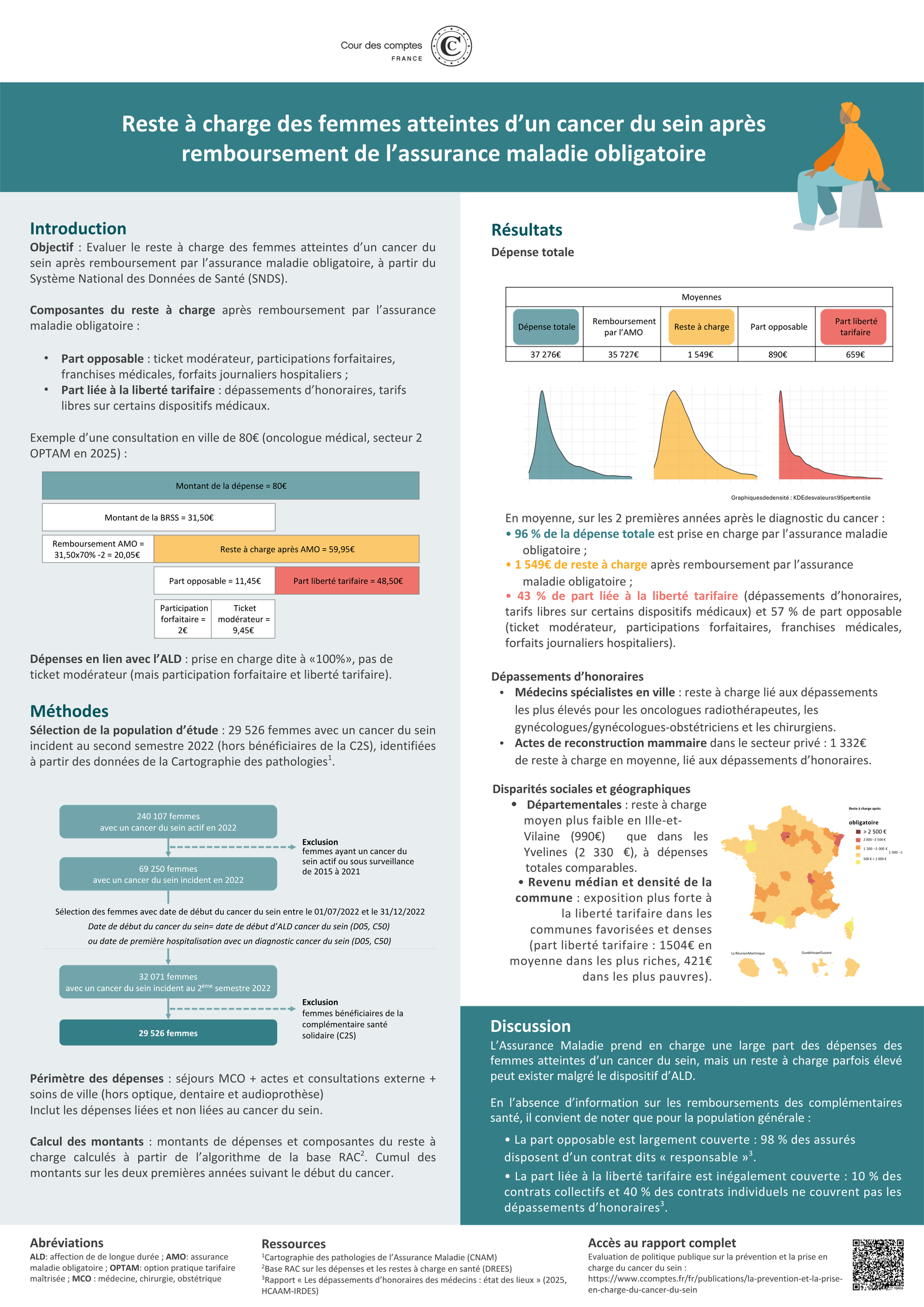
The analysis focused on a cohort of nearly 29,000 women diagnosed with breast cancer in 2022. For each of them, all expenses observed during the two years following diagnosis were examined: hospitalizations, medical consultations, medical procedures, medications, medical devices, and medical transportation.
Out-of-pocket costs after mandatory health insurance cover a range of different expenses. The first component corresponds to the so-called “enforceable” portion, the difference between the reference rate and the reimbursement provided by mandatory health insurance. A second component results from the freedom to set prices associated with certain healthcare services, particularly in the form of extra fees (above standard tariffs)charged by healthcare professionals.
To estimate out-of-pocket costs, the DASD of the French SAI adapted an algorithm developed by the Ministry of Health’s statistical service, which required significant methodological work and a specific adaptation for breast cancer. This tool allows for the estimation of total expenses, reimbursement by mandatory health insurance, and the remaining out-of-pocket costs.
Objectively Assessing the Role of Extra Fees Charged by Healthcare Professionals
The findings have provided objective data on phenomena that are often discussed but rarely quantified: in the two years following their diagnosis, women with breast cancer incur an average out-of-pocket cost – after reimbursement by mandatory health insurance and before any potential reimbursement by supplemental health insurance – of €1,550 out of a total expenditure of €37,280.
Beyond this average amount, the results highlight the central role of extra fees charged by healthcare professionals in determining the out-of-pocket costs. This phenomenon is particularly pronounced for certain medical specialties, such as radiation oncologists, gynecologists, and surgeons, and in certain regions.
The analysis also shed light on specific situations, such as breast reconstruction performed in the private sector, which are an integral part of the breast cancer care pathway but can result in significant out-of-pocket costs due to extra fees charged by healthcare professionals.
It was important to objectively assess the impact of these extra fees on out-of-pocket costs. Indeed, their coverage by supplemental health insurance varies greatly depending on the policy, which is likely to exacerbate socioeconomic inequalities regarding healthcare expenses.
An Award at the EMOIS 2026 Conference
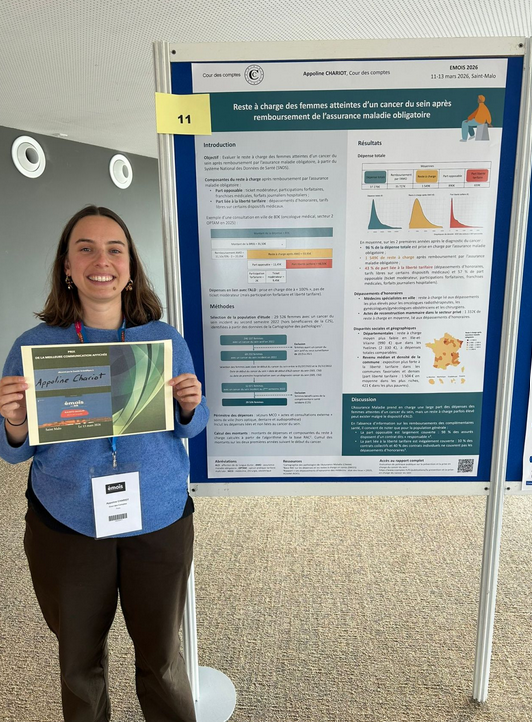
The results of this analysis, presented at the EMOIS 2026 medical information conference, received the award for best poster presentation for the poster titled “Out-of-Pocket Costs for Women with Breast Cancer After Reimbursement by Mandatory Health Insurance.”
This award highlights the scientific and practical value of work conducted as part of a public policy evaluation. It also illustrates the role of the French SAI’s “Analysis and Data Science” department: transforming complex data into useful information to inform findings, objectively assess observed inequalities, and enhance the relevance and impact of public policy evaluations.
Link to the report and its methodology document (in French)