The Working Group on Financial and Economic Stability Focuses on Auditing Nontraditional Financial Infrastructure During its Thirteenth Annual Meeting in Washington, D.C.
By Christine Ramos, U.S. Government Accountability Office
The INTOSAI Working Group on Financial and Economic Stability (WGFES) held its thirteenth annual meeting on May 6–7, 2026 at the U.S. Government Accountability Office (GAO) in Washington, D.C. Nearly 60 representatives from 23 supreme audit institutions (SAIs) attended the two-day meeting. The event focused on the theme Beyond the Bank: Auditing Nontraditional Financial Infrastructure and featured talks with academics, presentations by SAIs on recent audit work, member discussion, and networking.
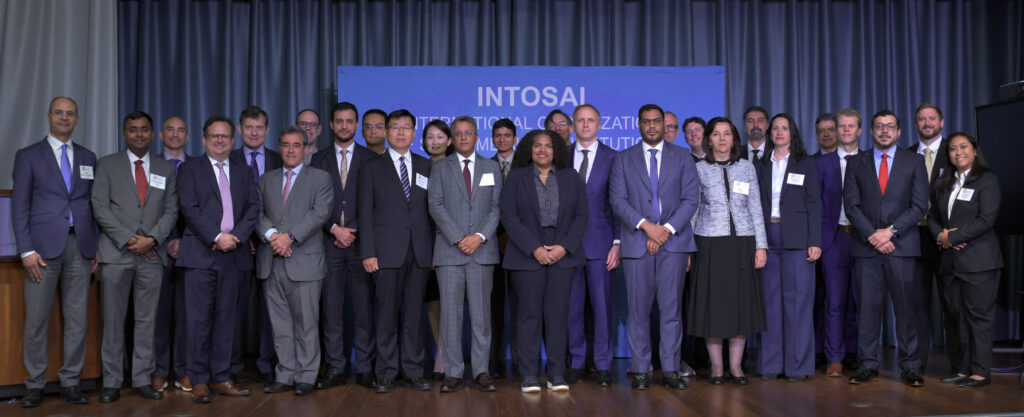
Acting Comptroller General of the Government Accountability Office, Orice Williams Brown, opened the first day of the meeting by welcoming attendees and acknowledging the important role that SAIs play in helping governments manage risks from nonbank financial products and services. Michael Rand, an Assistant Dean at the George Washington University Law School, then presented on the financial stability risks of private capital. These risks include limited transparency of terms, a lack of access to central bank liquidity, and increased exposure for consumers through retail channels. The morning concluded with two SAIs presenting work on supervising pension funds. Both presentations discussed opportunities to further strengthen supervisory frameworks, including better defining the expertise needs to conduct pension supervision and improving the transparency of pension gaps by using tracking systems and dashboards. Later in the day, Tobias Adrian, Financial Counsellor and Director of the Monetary and Capital Markets Department of the International Monetary Fund, presented on world economic and market trends related to nonbank financial institutions. In addition, members from two SAIs presented on their experiences auditing nonbank financial institutions in their countries. These institutions provide various financial services and products to consumers, such as insurance, wealth management, and loan origination. A key theme across both presentations was weak internal controls at the regulators, particularly the ability to identify and address the risks inherent to these activities carried out by nonbanks.
The second day of the meeting started with a presentation by James Angel, an Associate Professor at Georgetown University, on the opportunities and risks associated with stablecoins. Throughout the remainder of the second day, six SAIs presented recent audit work on infrastructure finance, central banks’ modernization efforts, and emerging risks from institutional capacity, among other topics. Common themes included the need for regulatory agencies to continuously build supervisory expertise in order to keep up with the pace of technology and improve interagency coordination as emerging financial products span multiple regulatory jurisdictions. In addition, a panel of analysts and specialists from GAO discussed innovative audit and investigative techniques. GAO panelists covered examples of various methodologies and technologies to conduct program evaluation, such as using national language processing to match data and launching covert investigations to test controls. Lastly, members discussed updates to the working group’s work plan, including sharing audit plans among members and gathering lessons learned from other INTOSAI working groups.
The WGFES is Chaired by the U.S. Government Accountability Office and remains open to all INTOSAI members. Please contact intosai-financial-stability@gao.gov for more information.