A Century of Change: The Albanian SAI’s Journey to Independence and Modernization
Author: Xhesila Nano PhD (c), Head of Communication and International Relations Directorate, Supreme Audit Institution of Albania
Introduction
As the independence of SAIs is the cornerstone of their ability to safeguard public resources, promote transparency, and strengthen trust in government, it is widely accepted in the international audit sphere that without institutional, financial and operational autonomy, audit findings and recommendations risk being influenced, underestimated, or ignored, undermining accountability. As such, through frameworks as the Lima and Mexico Declarations, it has been consistently affirmed that independent SAIs are essential pillars of democratic governance. Yet, independence is not a fixed state as it requires protection and adaption to dynamic realities.
In this context, on May 20th, 2025, the Supreme Audit Institution of Albania (ALSAI) celebrated its 100th anniversary, which presents a meaningful occasion to reflect its complex journey towards institutional independence. Over the course of a century, ALSAI has operated under vastly different political systems, from monarchy to a tightly controlled communist regime and finally to a developing democracy with growing aspirations for transparency, accountability and good governance. Throughout the years, ALSAI has faced numerous challenges in preserving and strengthening its independence, which have shaped its institutional identity and guided its efforts toward modernization and international alignment. This article explores the path of ALSAI throughout history, while analyzing its independence in each phase, concluding on the key points on the legal, structural, and professional conditions necessary to safeguard and strengthen SAI independence in the context of democratic governance and European Union (EU) integration.
From a New Independent Government to Communism
The foundations of financial oversight in Albania were laid soon after declaring the independence in 1912, when the newly formed government recognized that managing public finances required not just collecting and spending funds, but also ensuring accountability. Early efforts to establish oversight structures included the proposal of a Council of Elders in the 1912 Vlora Assembly to support government accountability, although this body never became functional. In the following years, several efforts were made to formalize financial control mechanisms, notably through the legislative developments in the early 1920s, including proposals to establish a more structured body to monitor state revenues and expenditures, but this institution functioned under the authority of the executive, limiting its autonomy.
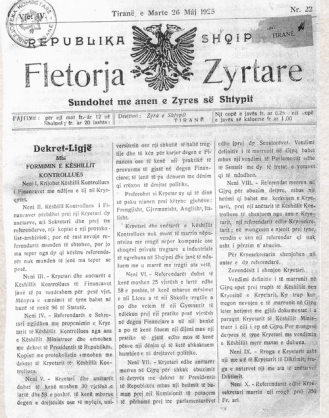
A major institutional milestone was noted in 1925 with the creation of the Control Council of Finances under the parliamentary republic. This marked the official beginning of public finance control in Albania. The council, modeled after the French Court des Comptes, was granted preventive and repressive audit functions and was formalized through the Foundational Statute, giving it constitutional status. Despite its formal establishment and legal framework, the council remained dependent on the executive branch and its members were appointed by the President of the Republic. Its existence served both an administrative purpose and a tool for the consolidations of state authority during a time of political centralization. This framework continued into the monarchy period (1928–1939), after the King replaced the 1925 Constitution with the Fundamental Statute of the Albanian Kingdom, which strengthened the formal status of the Control Council by explicitly stating that it was independent in the exercise of its duties. However, despite this recognition on paper, the reality remained largely unchanged, as the Council operated under significant influence from the royal administration.
During the communist era from 1945 to 1991, the oversight audit body operated without any institutional independence, under different names and organizational structures. The audit function was absorbed into the broader machinery of state control, with institutions such as the State Control Commission and later State Inspection tasked with overseeing financial activity in strict alignment with party directives while ensuring compliance with centralized economic plans. Frequent restructuring and limited mandates reflected their lack of autonomy, and the concept of independent external auditing, as understood today, was absent throughout this period.
The Path Toward Independence and EU
Following the collapse of the centralized communist system and a turbulent transition period in the early 1990s, the foundations for democratic governance began laying in Albania. The adoption of a new law by the Albanian Parliament on 1997, officially named the institution the Supreme State Audit (Kontrolli i Lartë i Shtetit). The law introduced important changes in line with international auditing standards. While in 1998, following the severe political and economic crisis of 1997, for the first time, the independence of the Supreme Audit Institution of Albania was formally established in the Constitution through Articles 162 to 165. The Constitution defined the institution’s authority and functions, the scope of its auditing activities, reporting obligations, and its relationship with Parliament. Importantly, the Constitution established that the Chairman would be elected by Parliament and not the executive, reinforcing the separation of powers. In 2000, amendments were made to the original 1997 law to reflect these constitutional provisions.
Further progress came in 2014 with the drafting and adoption of Law No. 154/2014, supported by the European Commission’s Directorate General for Budget, Support for Improvement in Governance and Management (SIGMA), and the EU Delegation in Tirana. This new legal framework brought the institution into full alignment with International Standards of Supreme Audit Institutions (ISSAIs). Under this law, ALSAI gained the authority to independently set its audit agenda, report directly to Parliament, and publish its findings, fostering greater transparency and accountability in the management of public funds. It also reaffirmed its functions as a depoliticized and non-partisan body.
Throughout years, ALSAI has also placed high importance on the exchange of experience and collaboration with peer institutions, viewing it as a vital component of institutional growth and professional development. As a member of both European Organisation of Supreme Audit Institutions (EUROSAI) and the International Organisation of Supreme Audit Institutions (INTOSAI), ALSAI has regularly participated in joint initiatives, training programs, thematic working groups, and peer reviews. These platforms provide valuable opportunities to share best practices, align methodologies with international standards, and stay informed on emerging trends in public sector auditing. This approach is strongly aligned with INTOSAI’s motto, Experientia Mutua Omnibus Prodest (Mutual experience benefits all), which reflects the core belief that shared knowledge and cooperation enhance the effectiveness of all SAIs. Through such engagement, ALSAI not only strengthens its own capacities but also contributes to the global mission of improving good governance.
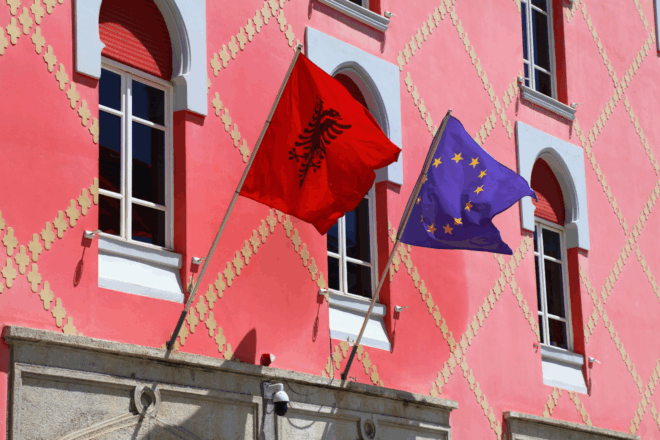
Moreover, as Albania continues its journey toward European Union membership, the independence and effectiveness of its oversight institutions, especially ALSAI, have taken on even greater strategic importance. The European Commission, in its annual progress reports, has consistently emphasized the role of Supreme Audit Institutions as guardians of public accountability, transparency, and the rule of law. A functionally and operationally independent ALSAI is core benchmark for aligning with EU Chapter 32: Financial Control, which assesses a candidate country’s ability to manage and audit public funds according to EU standards.
Conclusions
As ALSAI marks its centenary, its journey underscores that independence is a continuous process of strengthening resilience against evolving pressures. This anniversary is not just a celebration of its longevity, but a reminder that the independence of a SAI must be continuously earned, protected, and reinforced. While the 1997 Constitution and the 2014 law laid solid legal foundations, true independence also depends on adequate resources, skilled human capital, and the consistent implementation of audit recommendations. Looking ahead, ALSAI’s role will be defined by how effectively it adapts to new challenges. The evolving nature of public sector governance, including increased complexity in financial systems, digitalization, and cross-border challenges, demands that Supreme Audit Institutions continuously refine their methods and expand their areas of expertise. By deepening cooperation with international peers, engaging with civil society, and maintaining transparency, ALSAI can ensure that its next 100 years are marked not only by formal independence, but by tangible impact in protecting the public interest and reinforcing democratic accountability.