Advancing SAI Independence Through the AFROSAI-E Model Public Audit Act
Author: Annerie Loubser, Wynand Wentzel, and Gordon Kandoro
Across Africa, the independence of Supreme Audit Institutions (SAIs) faces growing pressure. Political transitions, fiscal crises, and governance challenges have, in some cases, led to attempts to limit the authority of SAIs, restrict access to resources, or interfere with the tenure of Auditors General. Such threats undermine not only the credibility of SAIs but also their ability to deliver impartial audits that safeguard public funds and strengthen trust in government. In this context, legislative, administrative, and financial independence is not a theoretical aspiration; it is a practical necessity for SAIs to fulfil their constitutional mandates without fear or favor.
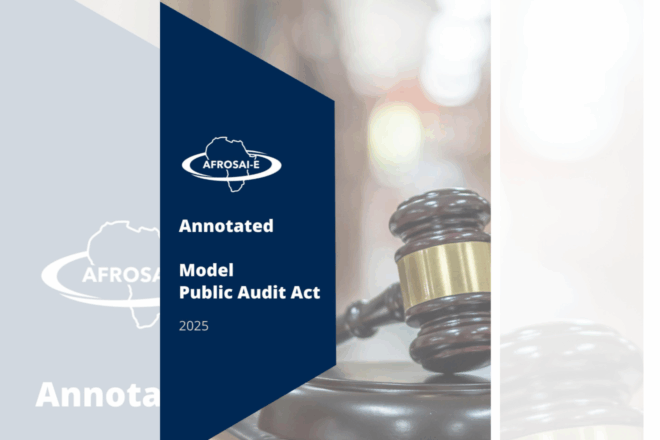
As a regional organization, AFROSAI-E plays a pivotal role in equipping its 26-member SAIs to respond to these risks. By providing tools, guidance, and platforms for peer learning, AFROSAI-E helps members identify vulnerabilities and strengthen their legal frameworks. One of the most significant initiatives in this regard is the Model Public Audit Act, developed with the support of the Deutsche Gesellschaft für Internationale Zusammenarbeit (GIZ)’s Good Financial Governance in Africa program.
The eight principles of SAI independence, as articulated by the International Organization of Supreme Audit Institutions (INTOSAI), provide a global benchmark. Yet, for many countries, the challenge lies in translating these principles into national legal frameworks that are clear, comprehensive, and enforceable. The Model Public Audit Act directly addresses this need by offering a best-practice legislative framework with modern provisions to safeguard and strengthen SAI independence. It is designed as a practical tool that countries can use to:
- Draft new audit legislation where none currently exists.
- Review or amend existing laws to address gaps in SAI legal frameworks.
- Engage parliaments, ministries of finance, civil society and other stakeholders to build a shared understanding of why legal independence matters.
A Collaborative and Consultative Process
Last year, AFROSAI-E published the draft Model Act for public exposure, inviting feedback from SAIs, legal experts, and governance stakeholders across the region. Building on this input, a group of regional legal experts convened in South Africa to review the draft Model Public Audit Act in detail and finalize it for publication.
The team of experts focused on ensuring that the framework reflects international standards while responding to the realities of the African governance landscape. Deliberations highlighted several practical issues often faced by SAIs, such as:
- Differentiating between the Auditor General (the individual) and the National Audit Office (the institution).
- Clarifying the relationship, powers, and responsibilities of the Auditor General.
- Defining the appointment and tenure of the Deputy Auditor General.
- Addressing misconceptions around who is authorized to sign audit reports.
These discussions underscored the importance of context-specific guidance. To support this, the Model Act includes annotations explaining how particular provisions can be adapted to different legal and institutional environments.
From Principles to Practice
AFROSAI-E is developing further guidance on SAI independence and legal frameworks, including model regulations, to complement the Model Act and provide further practical support. These supplementary guides and tools will:
- Define the conceptual foundations of independence, drawing from the Lima, Mexico, and United Nations declarations.
- Introduce the AFROSAI-E Institutional Capacity Building (ICBF) self-assessment approach to identify and mitigate threats to independence.
- Benchmark regional and global best practices within the INTOSAI community.
- Provide guidance on ensuring role clarity of Boards or Commissions without infringing on the independence of the head of the SAI.
- Equip SAIs to engage with executive and legislative stakeholders when advocating for legal reforms.
Pathways Forward
The Model Public Audit Act is a powerful tool for SAIs and their advocates to promote legislative reforms that strengthen independence, enhance credibility, and ultimately increase the impact of public auditing. By grounding the INTOSAI principles of independence in enforceable national law, countries can take decisive steps to ensure their audit institutions have the freedom, mandate, and resources to fulfil their constitutional role—without fear or favor.
The Model Public Audit Act was officially launched at the 20th AFROSAI-E Technical Conference on 9 October 2025. It is publicly available on the AFROSAI-E website: www.afrosai-e.org.za.
In a context where SAI independence remains both a challenge and a triumph, the AFROSAI-E Model Public Audit Act represents a concrete pathway forward—transforming principles into practice and aspirations into lasting institutional safeguards.